Wednesday, 29 May 2019

Danish World War One Uniform (M/1915) | Dansk 1915 Uniform

Danish uniforms between 1889-1945. Here are shown the following patterns (from left to right):
1889(92), 1903, 1910, 1915 and 1923. Notice that helmets were first introduced in 1923 and that the 1903 pattern were of a "green-grey" wool - not karkee. The kepi remained the same seize and shape, only changing the colour before finally being redrawn from service with the introduction of the helmet. 

----------------------------------------------------------------------------------------------------------------

Following the outbreak of war in august 1914 it became evident for the Danish army that the M/1910 uniform had its shortcomings. Especially the colour was ill chosen for the modern battlefield. However, change happened slowly as the Danish army had partially mobilised 50-55.000 men in the first months. They needed to be clad, fed, and armed - and any changes to uniforms and equipment had to take the back seat the first couple of months. 

Undoubtedly inspired by the German uniforms the Danish army decided in 1915 to introduce a light-grey uniform. It was decided that the uniform should retain the design from the earlier pattern (M/1910) and the colour codes used with the M/1910 and 1889 (1892).

Uniform model 1910:
Infantry units would wear: 
Light blue kepi with black leather and "silver" buttons. 
Dark blue jacket with "silver" buttons and red piping.
Light blue trousers - folded at the bottom and worn outside the boots. 
Artillery, medical and other "support" regiments:
Dark blue kepi with black leather and brass buttons. 
Dark blue jacket with brass buttons and either (depending on regiment) light blue, maroon, green, grey or yellow piping.
Dark blue trouser - unfolded and worn over the most of the boot. 
Uniform model 1915:
Infantry:
Grey kepi with black leather and "silver buttons.
Grey jacket with "silver" buttons and red piping.
Grey trousers - folded at the bottom and worn outside the boots.

Artillery, Medical Corps, logistics, engineers, Pay Corps, Technical Corps, etc.
Same cut and cloth as above but with brass buttons.
Depending on the unit / regiment the uniform had light blue, maroon, green, grey or yellow piping.
As a rule the trousers were worn unfolded.
 
--------------------------------------------------------------------------------------------------------------------

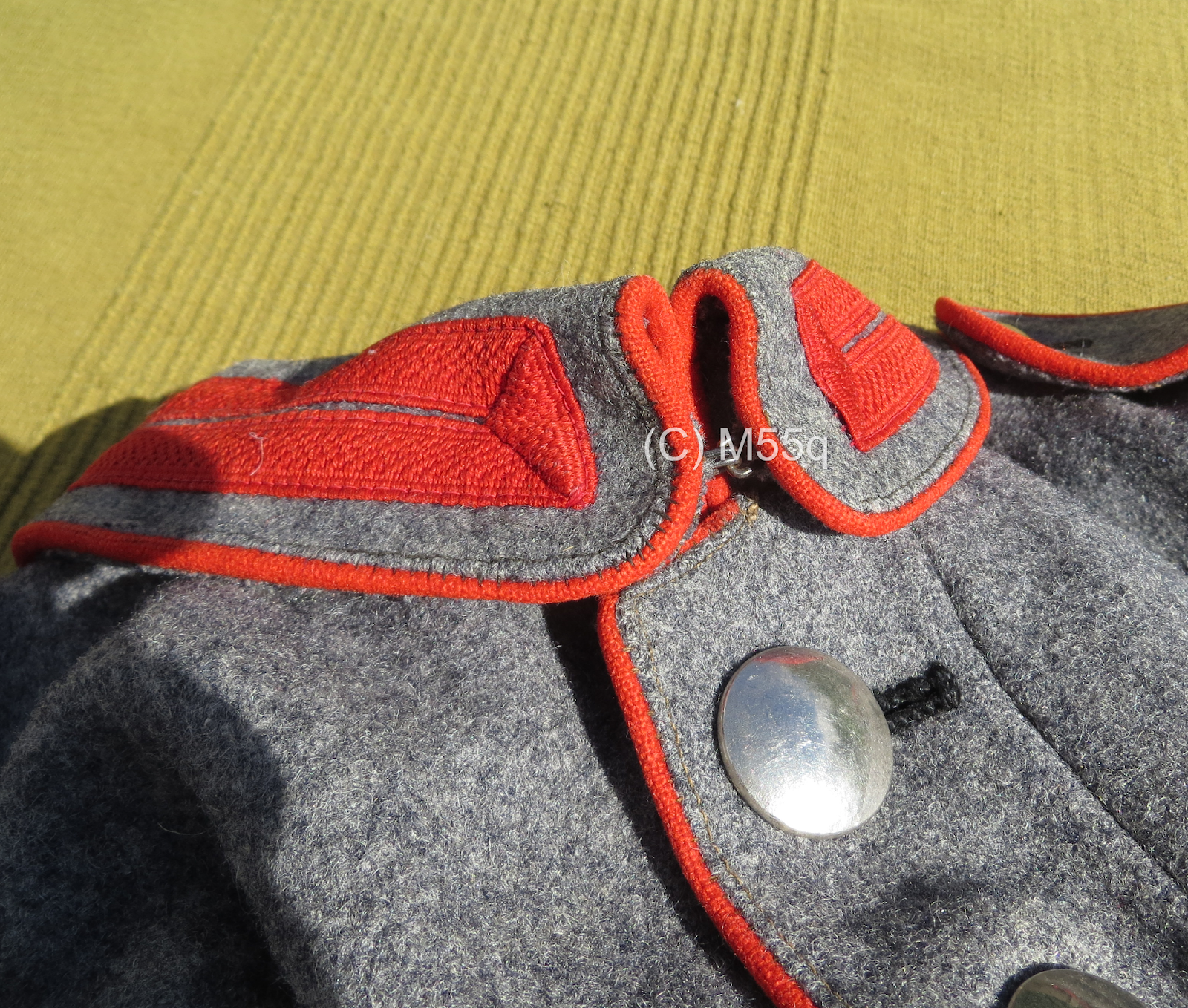
Following photos are of a M.1915 uniform from 1918 that belonged to a sergeant in the infantry. It took a while for the 1915 uniform to be issued to all units. Some units did not received it before the end of the war, and the engineers, technical corps, and the artillery did not receive them before the 1920s! 


The kepi belonged to a man in the 5th battalion.


The jacket is stamped: 1918 PRM. PRM = Prøvemæssig, i.e. that the uniform is made according to the official pattern.


It is fully lined - and must have been warm.

The small button hole on the shoulder strap is for a battalion number in "silver". Unfortunately it is missing from this uniform.


Tuesday, 28 May 2019

Swedish linjestång M/1918 (+ Inkopplingskrok M/1926 & Trådgaffel M.1918)

Linjestång M.1918 is heavy - but compact. The leather is heavy duty and all parts are made to last.

From time to time an item turns up that you have never seen before - but when you see it you need to own it. The above is such an item.

The field telephone revolutionised army communications in the early 20th century. Not in the same way as the telegraph had in the 19th century - but almost. It was faster but not necessarily more reliable. Phone cables were often cut by both friendly and enemy shells, tapped, and otherwise ruined or compromised. It was not uncommon during World War One that the phones only worked in the beginning of an attack. However, it was impossible to live without and cables were strung up all over the front line.


The above tool was used when making an 'air line' - i.e. when the cable was drawn between poles, trees, or buildings in the open air. In the British army during World War One the goal was to erect 1 mile per hour according to the Instruction in army telegraphy and telephone (The War Office 1914, p. 19) - and a air line detachment should be able to do no less than 5 miles of air line per day and "do an average day's march" (p. 19).


In the Swedish army the line men had an array of different tools at their disposal when erecting air lines. One of them was the above 'linjestång' - introduced in 1918. The idea was the line men could assemble the different sections into a long pole - and with the appropriate tool fixed at the end, either an 'inkopplingskrok' (hook) or a trådgaffel (cable fork), it was possible to guide and lift the cable into place. No need for a ladder!

Contents of the kit: 

The kit comes in a leather "quiver" (linjestångskoger) that holds four sections of pole, two cable forks, two hooks, and two pieces of cable.

The two cable forks are 1918 models but the two hooks are model M.1926.


Everything - even all flaps, straps and metal parts are stamped.

Bottom of the "quiver".

Cable fork M.1918

Cable fork M.1918 - one is in steel and the other is in aluminium.

Hooks


Old telephone cable.

Four sections of pole.


Monday, 12 February 2018

Review: 'Field Equipment of the European Foot Soldier 1900-1914' | 'Sac au dos. Études comparées de la tenue de campagne des fantassins des armées française et étrangères.'

Cover (front), 1994 version

Versions:

1) The original 1902 version was written / compiled by Commandant, Émile-Charles Lavisse (1855-1915), and published by the French army.

2) The 1906 version is (US) English translation of the original, with amendments by the US Army. The section with US Equipment was removed, although bits of information remains in chapter two of the book. It is taken for granted that the reader has an intimate knowledge of the US basic equipment of the late 1890s - early 1900s.

3) The 1994 reprint of the 1906 version. Added the British Patt. '08 webbing as an appendix.

Original title: Lavisse, Émile-Charles. Sac au dos. Études comparées de la tenue de campagne des fantassins des armées française et étrangères. Paris, 1902.

1994 reprint: Lawton, Edward P. (trans.) & Lavisse, Émile-Charles. Field Equipment of the European Foot Soldier 1900-1914. Nashville: The Battery Press. In association with The Imperial War Museum and Articles of War Ltd., 1994. 

-----------------------------------------------------

When reading the English translation of Sac au dos, one wonders if the US army in 1906 had no one better at translating French, than Capt. Edward P. Lawton. However,  the original French version was (and still is) not known for its prose, and one can easily understand why it was difficult to translate.

Translation aside, this review is based on the English reprint from 1994 as it is the version most - if not all - potential readers will have easy access to.

The book is a treatise by Lavisse in two parts: 

Chapter one expound in detail the basic equipment of the 1890s in France, Germany (Prussia), Great Britain, Austria, Belgium, Denmark, Spain, Italy, Norway, The Netherlands, Russia, Sweden, and Switzerland. It is important to note that although the 1994 reprint of the 1906 version incorporates all the changes made by the US Army to the original text, most accounts are still based on the observations and informations compiled by Lavisse in the late 1890s. E.g.: The section about Great Britain in the 1902 version only mentions the Valise Equipment, Pattern 1888 - aka the "Slade Wallace Equipment". An antiquated design - even by 1890s standards, that was replaced by the Bandolier Equipment 1903 as a consequence of lessons gained in the Boer Wars. However, the US translation from 1906 does not mention this change, even though the 1903 Bandolier Equipment saw use in 1906. The same problem is evident when it comes to Denmark, where the uniform and equipment changes in 1903 are wholly absent. Hence why, it is evident that the publishers preface from 1994 overvalues the amount of new information the 1906 version gained from being: "... revised by American military attaches to reflect any changes from the original edition." (p.7).

Based on the observations in the first chapter, Lavisse argues in chapter two, that the French army needed to change its basic equipment and uniforms. The chapter presents and explains in great detail the problems and possibilities offered by each individual piece of equipment that turn of the century soldiers depended on. From great coats, entrenching tools, boots, and belts. Everything is covered, and it is interesting to note that Lavisse was a strong advocate for uniforms in "neutral" or "earthy" colours (p.71-77). It is well known that the French soldiers in 1914 wore bright red trousers and caps, a costly error that could have bee avoided had the men responsible listened to Lavisse in 1902. Especially considering that Lavisse argues the colour-scheme of the French uniforms were a problem as early as the Franco-Prussian war of 1870-71 (p.73).
In regards to leather care, Lavisse is no lover of the international practise at the time of blackening the leather equipment (as done in e.g. France and Denmark.) "Does one ever see on the feet of the hunter or of the mountain climber a polished shoe?" (p.87) he asks rhetorically - and the short answer is of course "no!" Leather polished to a mirror finish hardens, cracks and becomes permeable to water - most certainly caused by the fact that shoe-polish in the late 1800s contained sulphuric acid.
Lavisse argues that time spent on polishing shoes and leather equipment is "a loss of time; how many hours used up without profit to military instruction. What a source of punishment. [...] Polishing might had its utility in the way of filling up leisure moments when the length of time of military service was long, but to-day, when the time passed with the colors is becoming shorter and shorter, when minutes are precious, why continue such methods? We inflict on our soldiers a task which displeases many of them, who are not necessarily for that poor soldiers." (p.90).

To surmise. Throughout the book Lavisse argues, that the army is first and foremost a fighting force, and must be equipped as such. Each soldier should carry just enough to keep him dry, warm, and relatively well fed. Uniform aesthetics are an irrelevant concern, and the individual solider should only worry about keeping his uniform clean and his leather equipment properly waxed. 

Apart from the ideas of Lavisse, the book is an excellent source to many interesting facts. The contents of packs, the weight of individual items, weight distribution, uniform colours, and other interesting and often forgotten facts are presented in an easy to read manner with many easy to use tables and illustrations. The book is perhaps on of the most comprehensive guides for the re-enactor and historian alike when it comes to the basic equipment of the 1890s - early 1900s.

Apart from its linguistic shortcomings, the 1994 reprint of Sac au dos is well worth a read. However, are you fluent in French the 1902 edition is still, by far, the best. The current publishers (The Battery Press; The Imperial War Museum, and Articles of War Ltd.) should contemplate re-naming the book: Field Equipment of the European Foot Soldier 1890-1914, since it is apparent that not much changed in 1906 when the book was translated into English.