Showing posts with label Danish army. Show all posts

Wednesday, 29 May 2019

Danish World War One Uniform (M/1915) | Dansk 1915 Uniform

Danish uniforms between 1889-1945. Here are shown the following patterns (from left to right):
1889(92), 1903, 1910, 1915 and 1923. Notice that helmets were first introduced in 1923 and that the 1903 pattern were of a "green-grey" wool - not karkee. The kepi remained the same seize and shape, only changing the colour before finally being redrawn from service with the introduction of the helmet. 

----------------------------------------------------------------------------------------------------------------

Following the outbreak of war in august 1914 it became evident for the Danish army that the M/1910 uniform had its shortcomings. Especially the colour was ill chosen for the modern battlefield. However, change happened slowly as the Danish army had partially mobilised 50-55.000 men in the first months. They needed to be clad, fed, and armed - and any changes to uniforms and equipment had to take the back seat the first couple of months. 

Undoubtedly inspired by the German uniforms the Danish army decided in 1915 to introduce a light-grey uniform. It was decided that the uniform should retain the design from the earlier pattern (M/1910) and the colour codes used with the M/1910 and 1889 (1892).

Uniform model 1910:
Infantry units would wear: 
Light blue kepi with black leather and "silver" buttons. 
Dark blue jacket with "silver" buttons and red piping.
Light blue trousers - folded at the bottom and worn outside the boots. 
Artillery, medical and other "support" regiments:
Dark blue kepi with black leather and brass buttons. 
Dark blue jacket with brass buttons and either (depending on regiment) light blue, maroon, green, grey or yellow piping.
Dark blue trouser - unfolded and worn over the most of the boot. 
Uniform model 1915:
Infantry:
Grey kepi with black leather and "silver buttons.
Grey jacket with "silver" buttons and red piping.
Grey trousers - folded at the bottom and worn outside the boots.

Artillery, Medical Corps, logistics, engineers, Pay Corps, Technical Corps, etc.
Same cut and cloth as above but with brass buttons.
Depending on the unit / regiment the uniform had light blue, maroon, green, grey or yellow piping.
As a rule the trousers were worn unfolded.
 
--------------------------------------------------------------------------------------------------------------------

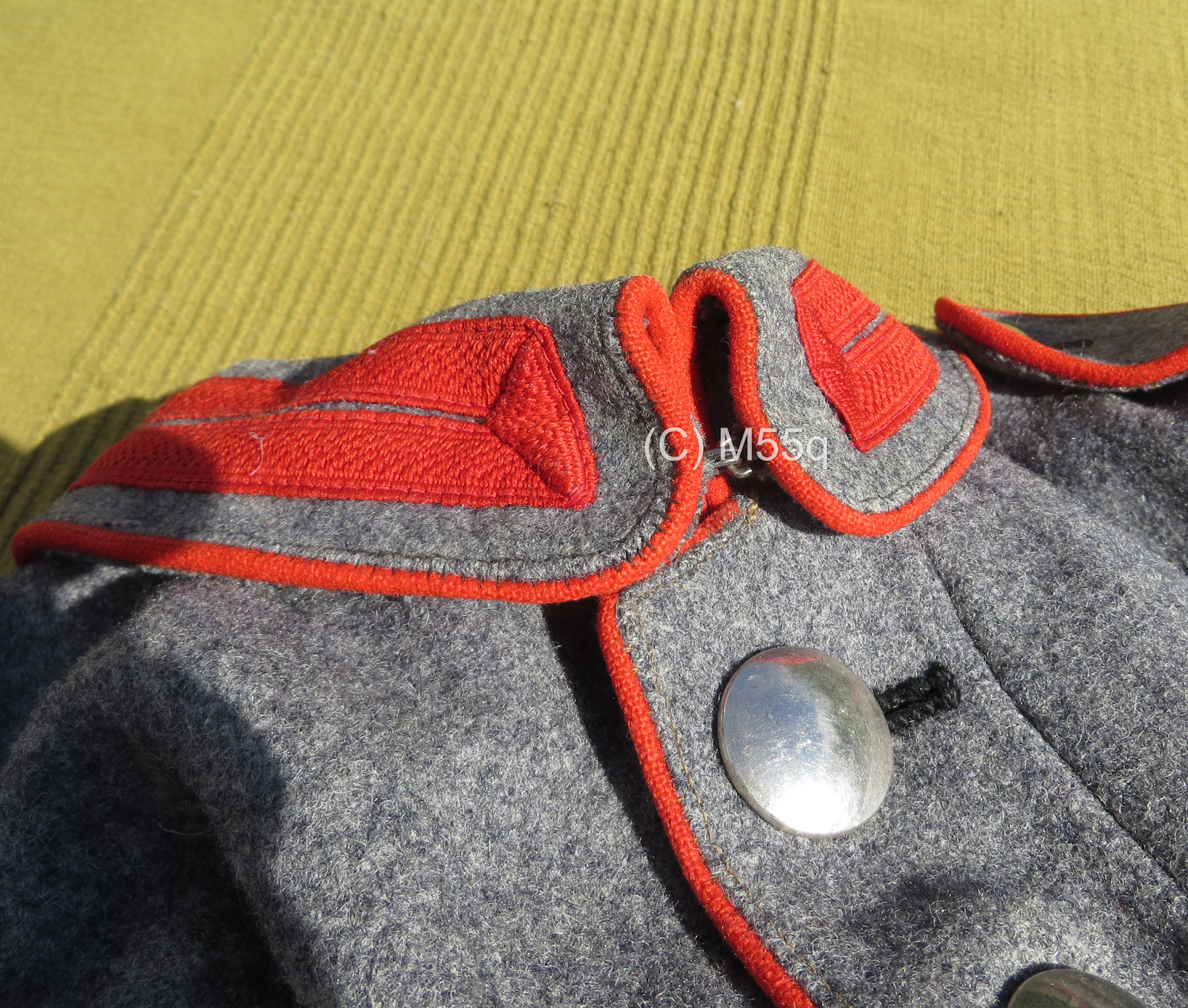
Following photos are of a M.1915 uniform from 1918 that belonged to a sergeant in the infantry. It took a while for the 1915 uniform to be issued to all units. Some units did not received it before the end of the war, and the engineers, technical corps, and the artillery did not receive them before the 1920s! 


The kepi belonged to a man in the 5th battalion.


The jacket is stamped: 1918 PRM. PRM = Prøvemæssig, i.e. that the uniform is made according to the official pattern.


It is fully lined - and must have been warm.

The small button hole on the shoulder strap is for a battalion number in "silver". Unfortunately it is missing from this uniform.


Wednesday, 3 April 2013

Danish M/1867 Remington bayonet - second pattern (1885)

Remember you can enlarge the pictures to see them in greater detail by "clicking" on the them.

The Danish M/1867 bayonet was made in Germany, in Solingen, by different manufacturers to accompany the, at the time, newly acquired Remington Rolling Block Riffle. 

In the aftermath of the devastating defeat against the Germans in 1864 the Danish army needed urgent modernisation. Politicians had believed the old equipment that secured the "victory" in the war of 1848-50 against Prussia and the insurgents of Holstein had been sufficient to secure the southern border and the Duchies of Slesvig and Holstein yet again. But the Danish muskets and artillery proved fatally outdated against the more modern Prussian army - and the combined might of the Prussian and Austrian forces. Although stiff resistance was put up, the weapons in the Danish arsenal could not compete with the range, accuracy and rate of fire the combined enemy forces could muster. 

As a consequence one of the many new acquisitions for the Danish army post 1864 was a breech loading riffle - the US Remington Rolling Block.  

The bayonet that accompanied this riffle was a Yataghan style bayonet. The French were the first to introduce a Yataghan style bayonet in the 1840s. The bayonet shape is based on the North African Yataghan sword, with its distinct curved blade. There are many theories on why they chose the Yataghan style blade: 1) The curve ensured that the blade was out of the bullet trajectory. 2) The Yataghan style was the best compromise between a thrusting weapon (bayonet) and a slashing weapon (sword) in the armies where soldiers up until then had carried infantry swords as well as bayonets, thus eliminating the need for both side-arms.  3) a purely stylistic choice. 

In the end the style became a major success. Almost all the worlds bayonet using countries fielded a Yataghan style bayonet at some time or another. 
------------------------------------------------


Metal fittings on the scabbard is made of steel. In Danish the fittings are called: "dupskoen" (the bottom part). The top part is called "mundblik".


The bayonet is of the second pattern produced post 1884 - 1885.
In 1885 they decided the press button in the locking mechanism should be made of steel. 


Serial number and makers mark. This particular bayonet is made by the company Alex Coppel. A quick google search should be able to give you a short company history. 


Crown stamp next to the locking mechanism. 


The holes in the carrier is for a corresponding button on the belt.


Sunday, 6 May 2012

Danish M/1873 water bottle (infantry)

 Above: A drawning of the M/1873 water bottle, this one for mounted troops, and the M/1895 water bottle. The last glass water bottle and the first aluminium water bottle in service wit the Danish army. The breaking point between the "good old days" and the industrialised 20th. century.
----------------------------------------

The M/1873 water bottle, is one of the longest serving water bottles in the Danish army. They continued to be used during the First World War with the reservist that manned the many fortifications during the war and it was not removed from service before the 1920s.

It came in two different versions. One for mounted troops, i.e., cavalry and one for infantry. 
The cavalry version had three leather loops, and a shoulder strap instead of a belt loop. The Guard Hussars where the only regiment that used a white shoulder strap. 
The bottle is made of clear glass and the cover is made of two pieces of leather. 
The leather is made from undyed cowhide. 
My bottle, like most of the other bottles out there, is missing its cork and it is 18,2 cm. tall.
It replaced the previous glass bottle, the M/1853/57, used during the war of 1864.


Sunday, 25 March 2012

Danish M/46 helmet

M/46 helmet 
--------------------------------------------------------------------------

The M/46 helmet was a failed attempt to make a helmet to replace the large amount of British Mk. II's, Mk. III's, Mk. IV's and Swedish M/37 in service with the Danish army in the aftermath of WWII.  

Production began in 1946 and was undertaken by the company Glud og Marstrand. The same company that produced the M/23 helmets before the war.
Right after the war they had begun production again and approximately 4700 M23/41 helmets for the navy were produced. Glud og Marstrand were the only company in Denmark with the capacity to produce the M/46 helmets in the numbers needed.

The M/46 helmet borrowed the shape of the shell from the Swedish M/37 helmet. For the untrained eye they look almost similar. The liner is often the best way to tell which one is which. The M/46 were made with two different type of liners. The first liners were scavenged Mk. II helmet liners! Later they made a US Style liner with webbing and plastic for the helmets used by the civil defence. Both type M/46 helmets used a US style chinstrap. Made out of khaki webbing. 

The chinstrap bales are fixed and spot-welded in place making the straps prone to breaking when used over a long period of time.  

They are found with a greyish / green coarse paint job. ( they mixed the paint with sand) and a smotth grey paint job. (For CF use) 

A total of 30.000 helmets were produced, and most ended up with the navy (they stopped using them in 1951) and the Civilforsvaret (civil defence). It was never adopted by the army (officially), since they adopted the US M1 helmet in 1948. (M/48)  

------------------------------------------------------------

Above: The front of the helmet.


Above: The rear of the helmet

Above: The interior. Notice the Mk. II helmet liner. 


Above: The chinstrap and buckle. It is made out of webbing and brass.


Above: Chinstrap bale... Spot-welded in place. 


----------------------------------------------

 Above: Swedish M/37 helmet for comparison.

Thursday, 15 March 2012

Danish M/49 gas mask

The mask with associated equipment: 1. Filter M/47, 2. Gas mask M/49, 3. anti dimming cloth, 4. Carrier 164.115-4, 5. two pair of protective goggles, 6. Manual, 7. Cleaning cloth.  
Remember! you can enlarge the picture by clicking on it! 

--------------------
The Danish M/49 gas mask is one of these items that everyone knows exist, but no one owns.
I was lucky enough to find one, with all the different items that normally are missing + the altered British carrier used together with the mask. (see the first picture) 

The mask is a re-design of the Danish M/38 gas mask that the army used from 1938 and until 1943. The M/38 (as did the M/31) saw some post war usage, but it was quickly replaced by this mask.

The stopped covering the mask in cloth, and the eyepieces can no longer be unscrewed to put in anti fogging discs. Instead they introduced an anti-dimming cloth. 
The mask is made of a one pice rubber part, an intake / exhale valve assembly, two eyepieces and a rather comprehensive strap system. The strap system exactly the same type of strap system used on the M/38 mask. All metal parts are made of aluminium, and the exhale / inhale valve assembly is down to the smallest detail the same as the M/38 mask.

The carrier is an interesting item, since it has been altered to meet Danish requirements. 
The C-hooks were cut off together with the shoulder strap rings. The C-hooks were then placed vertically together with two green webbing straps and two new buckles. This made it possible to carry the carrier in a vertical position, instead of the horizontal position as the British intended.      


Tuesday, 23 March 2010

Danish army insignia. Pre. WWII

(Click on the picture to enlarge it)

First row (from top to bottom) with the forage caps and pilot wings:
First forage cap is officers and connets.
Second forage cap is officiants and sergeants.
Third and last forage cap, is other ranks.
-------------------------------------------------
First row (cap badges) from left to right:First one: Cap badge general rank (General)
Second one: Cap badge senior officers.
Third one: National Cockade
Fourth one: Other officers and Officiants
Last one: Cap badge NCO's and other ranks.
------------------------------------------------
Second row: Officer shoulder boards:
#1: General
#2: Lieutenant general
#3: Major General
#4: Colonel
#5: Lieutenant colonel
#6: Captain (Reserves)
#7: Captain
#8: Lieutenant
#9: Lieutenant (Reserves)
#10 2nd Lieutenant
-----------------------------------
Third and last row - Shoulder boards:
#1: Corps officiant
#2: Staff officiant
#3: Senior officiant
#4: Officiant
#5: Connet
#6: Sergeant major
#7: Sergeant
#8: Corporal
#9: Lance corporal
#10: Helmet badge
------------------------------------------

The picture is taken from: "Lærebog for Hærens Menige" - that belonged to my grandfather.

Tuesday, 23 June 2009

Danish M23 helmet (Army version)

(Danish soldiers: 1940's)
---------------------------------------------------------------

The M23 helmet was introduced the same year as the first real khaki uniform.
(More correctly referred to as yellow-brown) It was the first helmet to enter service in Denmark.

They were produced by the company A/S Glud og Marstrands Fabriker in Copenhagen.
Each helmet is made of one single piece of steel, rim, liner, a chinstrap and a decal.
It weighs ca. 1600 grammes - about 3,53 Lbs.

 Notice the front decal. Three lions with nine hearts and oak-leafs around.


A better look at the decal.


The rear of the helmet.
Notice the hanging slot in the rear skirt of the helmet.
When in "marching" order, the soldiers strapped the helmet onto their knapsacks,
and wore the "garrison cap" instead. 


The brass plate underneath the liner...
The name of the company, and the serial number (83017)


The liner... Notice the eight leather flaps... All in great condition, age considered.
The leather adjustment-cord is original to the helmet.


 The unmistakeable Danish profile.

Additional information: 

The helmet is designed by Captain in the army HE, Johnsen.  
There are two main versions of the army helmet: 1) A size "normal" 90% of the helmets. 2) A size "large" - about 10% of the helmets.
The navy had an anchor as helmet decal. 
They are made from Swedish steel thickness = 1,2mm
The first 1924 helmets had two ventilations slots.
In 1924, 1926 and 1929 the design of the liner, steel thickness and some other small features (chinstrap among others) was altered slightly.

----------------------------
Source:  Om den danske stålhjelm m/1923, Våbenhistoriske Årbøger, nr. 48 / 2003 - Pages: 123-179 by Frans Løvschall and E. Kandborg
----------------------------