Showing posts with label uniform. Show all posts

Wednesday, 29 May 2019

Danish World War One Uniform (M/1915) | Dansk 1915 Uniform

Danish uniforms between 1889-1945. Here are shown the following patterns (from left to right):
1889(92), 1903, 1910, 1915 and 1923. Notice that helmets were first introduced in 1923 and that the 1903 pattern were of a "green-grey" wool - not karkee. The kepi remained the same seize and shape, only changing the colour before finally being redrawn from service with the introduction of the helmet. 

----------------------------------------------------------------------------------------------------------------

Following the outbreak of war in august 1914 it became evident for the Danish army that the M/1910 uniform had its shortcomings. Especially the colour was ill chosen for the modern battlefield. However, change happened slowly as the Danish army had partially mobilised 50-55.000 men in the first months. They needed to be clad, fed, and armed - and any changes to uniforms and equipment had to take the back seat the first couple of months. 

Undoubtedly inspired by the German uniforms the Danish army decided in 1915 to introduce a light-grey uniform. It was decided that the uniform should retain the design from the earlier pattern (M/1910) and the colour codes used with the M/1910 and 1889 (1892).

Uniform model 1910:
Infantry units would wear: 
Light blue kepi with black leather and "silver" buttons. 
Dark blue jacket with "silver" buttons and red piping.
Light blue trousers - folded at the bottom and worn outside the boots. 
Artillery, medical and other "support" regiments:
Dark blue kepi with black leather and brass buttons. 
Dark blue jacket with brass buttons and either (depending on regiment) light blue, maroon, green, grey or yellow piping.
Dark blue trouser - unfolded and worn over the most of the boot. 
Uniform model 1915:
Infantry:
Grey kepi with black leather and "silver buttons.
Grey jacket with "silver" buttons and red piping.
Grey trousers - folded at the bottom and worn outside the boots.

Artillery, Medical Corps, logistics, engineers, Pay Corps, Technical Corps, etc.
Same cut and cloth as above but with brass buttons.
Depending on the unit / regiment the uniform had light blue, maroon, green, grey or yellow piping.
As a rule the trousers were worn unfolded.
 
--------------------------------------------------------------------------------------------------------------------

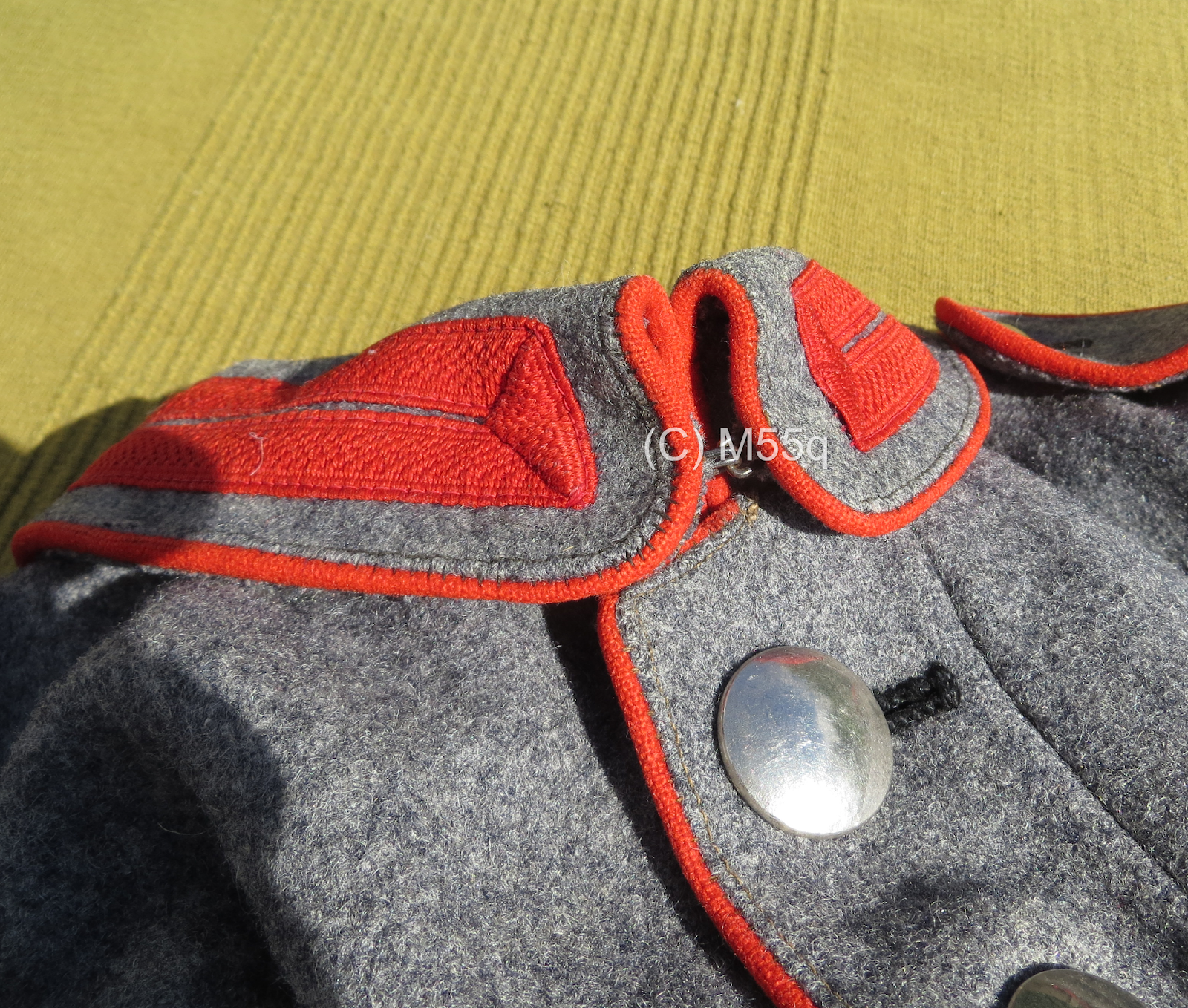
Following photos are of a M.1915 uniform from 1918 that belonged to a sergeant in the infantry. It took a while for the 1915 uniform to be issued to all units. Some units did not received it before the end of the war, and the engineers, technical corps, and the artillery did not receive them before the 1920s! 


The kepi belonged to a man in the 5th battalion.


The jacket is stamped: 1918 PRM. PRM = Prøvemæssig, i.e. that the uniform is made according to the official pattern.


It is fully lined - and must have been warm.

The small button hole on the shoulder strap is for a battalion number in "silver". Unfortunately it is missing from this uniform.


Tuesday, 30 December 2014

Danish M/1910 kepi for the infantry | Hue M/1910, infanteriet, for menige.

Danish uniforms between 1889-1945. Here are shown the following patterns (from left to right):
1889(92), 1903, 1910, 1915 and 1923. Notice that helmets were first introduced in 1923, and that the 1903 pattern were of a "green-grey" wool. The kepi remained the same in seize and shape, only changing the colour, before finally being redrawn from service with the introduction of the helmet.
--------------------------------------------------------------------------------------------------------

Following extensive troop trials in 1901-1902 the Danish army introduced a "green-grey" uniform in 1903 with brown leather cartridge carriers and belt - and a back pack and haver sack in the same colour as the uniform. It had a loose cut with a turn down collar and hidden buttons. Not unlike the German 1915 uniform.

It did however not last long in service. The green colour and the loose cut met fierce resistance from certain circles in the armed forces - most from the officers. Most of the army reverted back to a uniform in dark blue in 1910 with black leather gear. The only regiment that kept the grey-green uniform was the Royal Guards where it soldiered on until 1923.

Uniform model 1910:
Infantry units would wear: 
Light blue kepi with black leather and "silver" buttons. 
Dark blue jacket with "silver" buttons and red piping.
Light blue trousers - folded at the bottom and worn outside the boots. 

Artillery, medical and other "support" regiments:
Dark blue kepi with black leather and brass buttons. 
Dark blue jacket with brass buttons and either (depending on regiment) light blue, maroon, green, grey or yellow piping.
Dark blue trouser - unfolded and worn over the most of the boot. 

---------------------------------------------------------------------------------------------------------------------

Following photos are of my own 1910 kepi. It's a standard infantry kepi in a larger unusually large size (about a 61-62 in Europe). It belonged to a private in the 4 battalion. Very little moth damage, and overall very little wear. The leather is however quite brittle and the rear steel support (to keep the shape) is bend a little. Apart from that it is in good condition - considering it has passed 100+ years.


---------------------------------------------------------------------------------------------------

Source:

Hvidt, A, The Danish infantry's uniforms and equipment through-out the past 200 years.

Friday, 19 December 2014

Belgian uniforms and equipment - 1950s-1960s


      Fig.1: The different uniforms in use from the end of WWII to the 1960s in the Belgian Army.
-------------------------------------------------------------------------------------------------------------------

Uniforms: Like many other countries, Belgium adopted a uniform in a British cut. A wool "battledress" uniform, with beret and low boots. During WWII the Belgians had  their own units, under British command, the Belgian Independent Parachute Company and SAS Squadron, and the post war Belgian army was heavily inspired by the war time experience.

The uniforms for the ariborne units consisted of a "Denison smock" type smock and trousers both in a camouflage pattern. In the 1950s the "moon and balls" and "brush-stroke" patterns were used (soldier no.5), but the well know and long lived "jigsaw" pattern was introduced in 1956. (soldier no.4). The Belgian army did however continue to issue existing stock of "moon and balls" and "brush-stroke" camouflaged clothes to para and commando units well after production halted.  The "moon and balls" pattern stopped production in 1956 and the "brush-stroke" pattern was discontinued at some time in the 1970s. The camouflage uniforms were primarily used in the different former Belgian colonies. Especially the Brush-stroke pattern can be seen worn during the Congo Crisis, and the uniforms were used by European mercenaries as well  in the Congo.

 This particular uniform (below) is a smock in "brush-stroke" pattern, and a pair of trousers in the "moon and balls" pattern. Trousers are made by RAKA in 1956 and the smock is made in 1956 by BAWI.


----------------------------------------------------------------------------------------------------------------------

Webbing: The Belgian army adopted a webbing very similar to the British patt. '37 webbing. The belt, braces, brace attachments, basic pouches (Mk.III), and other bits and pieces were all directly copied from the British webbing. But, like many other countries, Belgium tried the British water bottle (the bottle, water, enamelled Mk VII) and entrenching tool (the '08 - "pick"). Both items were found wanting, and they looked for more suitable replacements. The Belgian army chose to use a version of the US M/1943 entrenching tool and US M/1910 water bottle and cup. They altered the carrier for both the entrenching tool and the water bottle, to fit the British style webbing belt.


Basic pouches: 

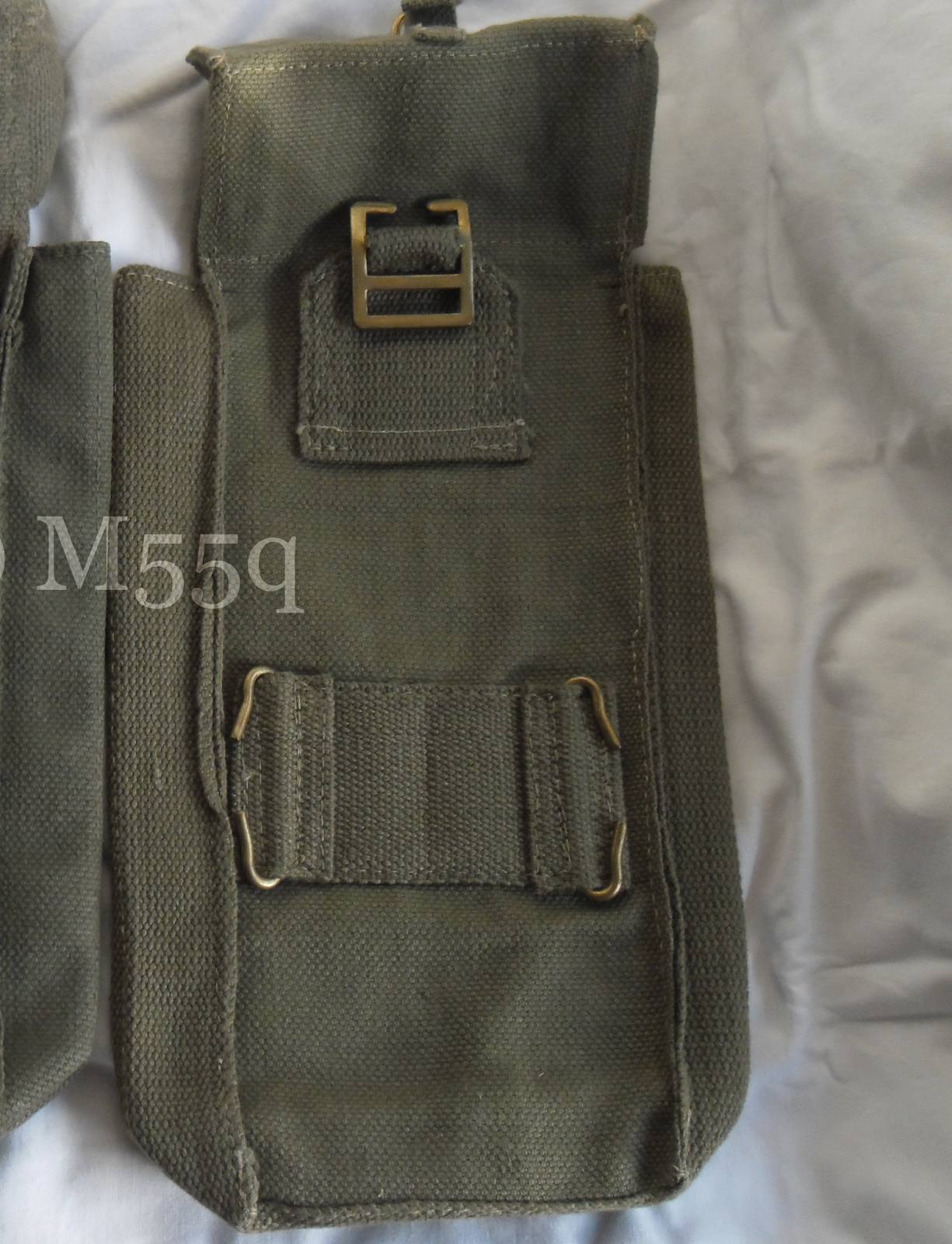
The most common pouch to be found these days are a direct copy of the British MkIII basic pouch, for the '37 webbing equipment (see below). But it is evident from period photos that the Belgian army used surplus British equipment for several decades after World War Two.


 Water bottle, cup and carrier:

The water bottle and cup is almost exactly the same, as the US M/1910 for dismounted. The carrier is only similar in overall style, with the addition of two buckles in "British" style on either side of the carrier. Internally, the carrier is covered in a thick felt, for insulation. Water bottle and cup are both made in 1960, by UMAL.


Entrenching tool carrier:

Similar to the US in every detail, except for the carrying arrangement, that is altered in order for the carrier to be worn on British style belts.


Belt, bayonet frog and pistol holster: 

Belt: Made in Belgium, and a direct copy of the patt' 37 webbing belt.

Frog: Frog, made for the FN FAL bayonet. In many ways similar to the frog for the No. 4 British bayonet.

Pistol holster: design is borrowed from the Canadian "Holster, C, No. 2, Mk. 1 " developed pre WWII for the Chinese military.