Fig.1:
The different uniforms in use from the end of WWII to the 1960s in the Belgian Army.
-------------------------------------------------------------------------------------------------------------------
Uniforms: Like many other countries, Belgium adopted a uniform in a British cut. A wool "battledress" uniform, with beret and low boots. During WWII the Belgians had their own units, under British command,
the Belgian Independent Parachute Company and SAS Squadron, and the post war Belgian army was heavily inspired by the war time experience.
The uniforms for the ariborne units consisted of a "Denison smock" type smock and trousers both in a camouflage pattern. In the 1950s the "moon and balls" and "brush-stroke" patterns were used (soldier no.5), but the well know and long lived "jigsaw" pattern was introduced in 1956. (soldier no.4). The Belgian army did however continue to issue existing stock of "moon
and balls" and "brush-stroke" camouflaged clothes to para and commando
units well after production halted. The "moon and balls" pattern
stopped production in 1956 and the "brush-stroke" pattern was
discontinued at some time in the 1970s. The camouflage uniforms were
primarily used in the different former Belgian colonies. Especially the Brush-stroke pattern can be seen
worn during the Congo Crisis, and the uniforms were used by European
mercenaries as well in the Congo.
This particular uniform (below) is a smock in "brush-stroke" pattern, and a pair of trousers in the "moon and balls" pattern. Trousers are made by RAKA in 1956 and the smock is made in 1956 by BAWI.
----------------------------------------------------------------------------------------------------------------------
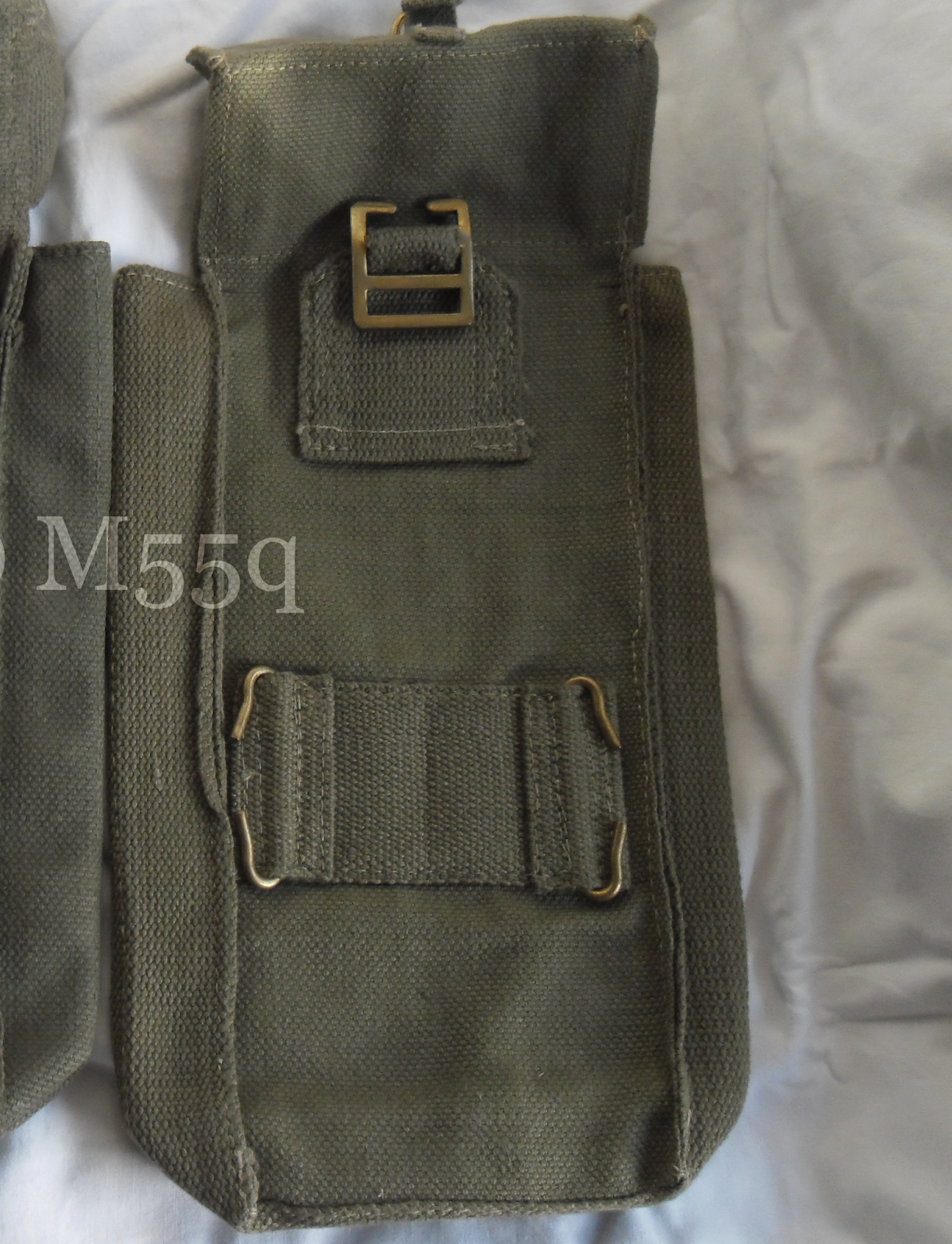
Webbing: The Belgian army adopted a webbing very similar to the British patt. '37 webbing. The belt, braces, brace attachments, basic pouches (Mk.III), and other bits and pieces were all directly copied from the British webbing. But, like many other countries, Belgium tried the British water bottle (
the bottle, water, enamelled Mk VII) and entrenching tool (
the '08 - "pick"). Both items were found wanting, and they looked for more suitable replacements. The Belgian army chose to use a version of the US M/1943 entrenching tool and US M/1910 water bottle and cup. They altered the carrier for both the entrenching tool and the water bottle, to fit the British style webbing belt.
Basic pouches:
The most common pouch to be found these days are a direct copy of the British MkIII basic pouch, for the '37 webbing equipment (see below). But it is evident from period photos that the Belgian army used surplus British equipment for several decades after World War Two.
Water bottle, cup and carrier:
The water bottle and cup is almost exactly the same, as the US M/1910 for dismounted. The carrier is only similar in overall style, with the addition of two buckles in "British" style on either side of the carrier. Internally, the carrier is covered in a thick felt, for insulation. Water bottle and cup are both made in 1960, by UMAL.
Entrenching tool carrier:
Similar to the US in every detail, except for the carrying arrangement, that is altered in order for the carrier to be worn on British style belts.
Belt, bayonet frog and pistol holster:
Belt: Made in Belgium, and a direct copy of the patt' 37 webbing belt.
Frog: Frog, made for the FN FAL bayonet. In many ways similar to the frog for the No. 4 British bayonet.
Pistol holster: design is borrowed from the Canadian "
Holster, C, No. 2, Mk. 1 " developed pre WWII for the Chinese military.